
Northern Nigeria Education Initiative Plus (NEI+)
Funding Partner: USAID-Nigeria/ Creative and Associates, Inc. (CAII)
Principal Investigator: Dr. Adrienne Barnes-Story / Dr. Helen Boyle
Project Announcement
LSI received an award from Creative Associates International as a subcontractor on the Northern Education Initiative + for Nigeria. The five-year project has the goal of improving early reading and math skills in three states in the north of Nigeria that have struggled with educational quality as well as regional instability. FSU’s main work will be with preservice teacher training institutes, working with State and Local Government Education Areas (LGEA) systems for in-service training to teachers in public, IQTE, and NFLC classrooms in the use of evidence-based reading materials improved and implemented.
FSU will collaborate with the National Council of Colleges of Education (NCCE) and Colleges of Education (COEs) to develop pre-service early grade reading syllabi and instruction courses for teacher trainees. FSU will be charged with NEI+ leadership in pre-service teacher training and curriculum development in Hausa and English reading instruction, as grounded in the latest research and best practices. The NEI+ team will work with NCCE and COEs to build pre-service training, including syllabi and EGR course content. The team will work with NCCE, COEs, and agencies to improve and expand the use of teaching practicums to shift the emphasis to practical learning in pre-service training and ensure that COEs in all states are in possession of the materials needed to integrate reading coursework into pre-service teacher preparation.
NEI+ will involve pre-service instructors and personnel in the Teacher Training Working Group (TWG), along with the Materials Development Working Group TWG, to ensure that materials for teachers' classroom use, in-service training and modules, and pre-service EGR instruction support, are aligned. We will ensure that successive cohorts of teacher trainees begin their careers equipped with a full set of instructional skills that will have a direct, positive impact on students' EGR outcomes.
The initial EGR pre-service courses will be delivered in Year 2, so newly hired graduates (about 250 per state usually) can apply the knowledge gained in primary schools in Years 3, 4 and 5. We estimate that in Years 3, 4 and 5, 2,250 teachers will have completed the NEI+ pre-service EGR program in three states and will reach 225,000 students in grades 1-3 with best practices in EGR instruction, resulting in improved student reading outcomes.
In addition, because FSU faculty have experience in working with Islamic schools, FSU will advise and consult on the following two activity areas:
- The adaptation of a core curriculum in reading for use in non-formal schools (specifically Integrated Quranic or Tsangya educational schools).
- The support of a core curriculum policy for IQTE schools, including the development of awareness of and support for core curriculum integration and improved school environment in IQTEs.
Finally, FSU experts will contribute research on such topics as integrated Qur’anic schools, community roles, and best practices in early grade reading in the northern Nigerian context; likewise, FSU will test the effectiveness of different schoolroom and supplemental materials, feeding into learning materials development, particularly for developing materials on conflict resolution and well-being.
2019 Update
November 26, 2019
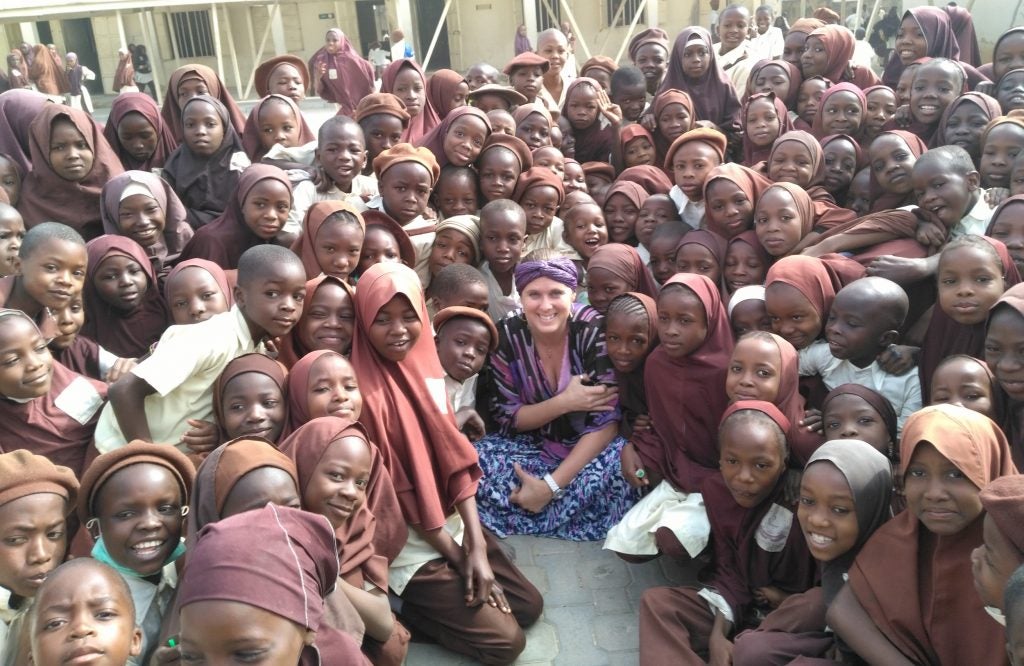
A first-grade classroom in northeast Nigeria can be a difficult place to learn.
Classes might be filled with 100 students, and although many children speak a regional language called Kanuri, teachers often give classes in Hausa, a wider-used lingua franca. Many of the students’ parents can’t read. Teachers may not be adequately trained. And classes are happening in a region where Boko Haram has launched attacks against schools and kidnapped students.
It’s in this challenging environment that researchers from Florida State University’s Learning Systems Institute are working to improve the educational landscape. Supported by $2.6 million in funding, researchers have embarked on a series of projects to improve teacher training and literacy to help these students gain some ground.
The Learning Systems Institute, an internationally recognized, university-based research and development organization, has a long history of work in Nigeria. On a trip to the region this year, Associate Professor of International and Multicultural Education Stephanie Simmons Zuilkowski saw a gleaming new school. She complimented the headmaster on the facility, and he informed her it was brand-new. It had been rebuilt after Boko Haram burned down the building for the third time.
“They just come back, and they build it again, and they keep on going,” Zuilkowski said. “It’s impressive. It speaks to people’s commitment to not letting Boko Haram win.”
TEACHER TRAINING
Millions of students across northern Nigeria will benefit from a pair of projects funded by the United States Agency for International Development (USAID).
The institute is a partner in the Northern Education Initiative Plus, a project to train about 20,000 teaching instructors and learning facilitators in reading instruction for young students. The project is implemented by the international development organization Creative Associates International.
The intervention helped teachers move from theory to practice in their classrooms. Instruction changed from simply exposing students to texts to classes that focus on developing skills.
One lesson involved writing letters on bottlecaps and teaching students that each cap represented a sound. The method teaches students to listen for individual sounds and to assign that sound to a letter. When students recognize the letter-sound correlations, they can combine the bottlecaps to create words. For the teachers, it was practice delivering lessons on phonics and vocabulary.
“They talked a lot about it, theoretically, but even the teacher-educators themselves had no idea how to actually do that in practice,” said Adrienne Barnes, an LSI research faculty member and the principal investigator for the project. In February, LSI members will visit the country to assess its impact.
Institute researchers are involved in other efforts to train the next generation of teachers in the country by establishing a reading research center at Bayero University in the city of Kano. As part of that USAID initiative, students from the university visit Florida State for a six-month period to take graduate classes in education and to work with a faculty mentor to design and implement a research project they carry out when they return to Nigeria.
It’s an important step toward long-term, sustainable progress in the country, said Zuilkowski, the principal investigator. Projects that rely on foreign experts eventually end. This project will create local experts in childhood reading and research, and their understanding of the on-the-ground conditions will lead to reading interventions specifically designed for Nigerian students.
“They are getting a really in-depth understanding of the current state of the research about what we know about how kids learn how to read,” she said. “We’re already starting to see that different organizations are reaching out to them when they return to work as consultants on their projects, which is really exciting because that tells us that other organizations value what we are doing and the skills the faculty are getting.”
A NEW CURRICULUM
The institute is also giving primary students in northeast Nigeria a chance to take elementary school classes in their mother tongue.
When students in that region start school, they often come from Kanuri-speaking homes. Their instruction, however, is in Hausa and English. An LSI project funded by the United Kingdom’s Department for International Development through UNICEF developed a curriculum for Kanuri-speaking students.
FSU researchers took a curriculum for early literacy and mathematics classes that had been developed in Hausa and worked with local translators and teachers to adapt it into Kanuri and test it with second-grade students. The curriculum is now being used in first, second and third-grade classrooms in two northeast Nigerian states.
Local partnerships were especially important for this work, Zuilkowski said. The researchers who were trained by FSU were able to go into areas that would have been dangerous for her and her colleagues in order to gather information on educational outcomes that was essential for testing the effectiveness of the intervention.
When the final product was ready for publication, the creators needed to name it. The local educators who worked with FSU researchers proposed “KARI,” which stands for “Kanuri Arithmetic and Reading Intervention.” It has a second meaning. In the Kanuri language, “kari” means “light” or “torch.”
“They were very excited with the name,” said Ana Marty, an LSI research faculty member and the principal investigator for the project. “It’s like this torch and this light that is coming to the schools with these materials. The children are learning to read in their language that they know from home. They come to first grade speaking Kanuri and now they see these materials and they can understand them because it’s the language that they know.”